In the words of a great Roman emperor Julius Caesar, “Experience is the teacher of all things.” I have chosen my niche based off my personal experience and wish to share my findings with you.
At the start of the 2008 year I hopped on a plane and flew almost 3 thousand miles to Europe where I first landed in London, England and shortly after moved to Rome, Italy to live for 5 months. During my stay in Rome I was able to experience a completely different lifestyle than the one I was living in the United States. I was able to travel each weekend to a different country to taste the food, hear the music, and experience their way of life.
Looking back over a year later, one thing sticks out in my mind more than anything, the food. Each country I visited had an array of foods which helped define the country and its culture. I chose my niche to be A Taste of Europe.
I have already begun to share some of the delicious dishes I ate while traveling abroad. If you’d love a nice meaty sandwich, definitely check out A Taste of Germany or A Taste of Greece. If you love sweet treats check out A Taste of France. Considering I lived in Italy I definitely have my favorite dishes I will need to share with you in the future, but as a teaser I offer a simple recipe to one of Italy’s finest desserts, an Italian Cannoli.
Now that I have created an online identity, I wish to increase my presence within my niche. I want my blog to offer people new ideas of dishes they may have never tried before. At the end of every piece I inform the reader of where these foods can be found in America. Not everyone has the opportunity to travel to another country, and I would like to bring a bit of Europe into their lives.
There are many steps I will take in order to increase my online presence. Here is how I will begin:
Increase my activity on Twitter. I plan to tweet more often. Not only about my recent blog posts, but interesting findings I come across in my research relating to European food.
Add tags to my blog. I am still figuring out how to do this but there are many key words and phrases I would like to tag in order to enhance my presence during a Google search. This will connect my name and blog directly to the food genre I wish to be a part of.
Insert links within my blog. There are many websites I come across while conducting research that I can incorporate more into my articles. Adding links to these outside sources within my niche will help to increase my presence as well as raise my credibility. This will allow readers to see some of the sources I get my information from as well as give access to more information if they wish to find out more.
Implementing these steps will help me to increase my presence on the internet. I currently do not have much to offer when my name is Googled. I have a common first name, Heather, and there are a few other people around the country have the last name Bacci. I wish to separate myself from the others and create a distinctive identity when “Heather Bacci” is searched on Google.
If you love food as much as I do, this is the perfect blog to indulge in. You will be introduced to a number of dishes from many different countries around Europe. Come hungry and dig into A Taste of Europe!
To what extent does an individual have a right to know the 411 on the food they are consuming? This has been a huge international issue for many years now and there is no end in sight for countries to decide on one global rule for the proper labeling of food products. The main concern lies in Genetically Modified Organisms (GMO) or more commonly known as GM foods. GM foods are food plants that have been genetically altered to enhance or suppress a specific trait. This could range from suppressing a plants vulnerability to a drought to breeding hundred of plants from a cell as opposed to a seed.
There are two extreme ends of the battle against a consumer’s right to be informed; Europe and the United States. Europe believes that a consumer has the right to know if the food they are consuming has been genetically modified. Recent laws established by the European Commission require all producers to label their products GM if they have been modified. The United States believes that the risks caused by GM foods are not high enough to spend the time and money to regulate proper labeling of GM foods. I side with Europe in this argument and believe that a consumer should have a right to know how their food is being produced and be given the choice to opt out.
GM Food Risks
There are many risks associated with GM foods that a consumer has the right to be aware of. The first category of risk is in the environment. Unintended harm to other organisms has been shown to be one of the biggest concerns. The most popular plant modification is pest resistance. The downside of this is there is there is no way of controlling the toxins released from these plants to only kill the pests that eat crops. All insects and animals are exposed to these toxins. Pollen from GM plants can spread by the slightest gust of wind resulting in the death of animals and insects outside the spectrum of crop eaters.
Another category of risk is human health. Considering the concept of GM foods is fairly new, long-term health risks have not yet surfaced. It needs to be considered that any time genes are modified, changes exist that can potentially lead to serious health risks. At this point, the consumer is basically eating at their own risk. The highest known short-term health concern for GM foods is allergies. It is possible that genetically modifying a plant may cause allergic reaction to a new and unidentifiable allergen. Due to the numerous amounts of people who have life threatening allergies, everyone needs to be careful when consuming GM foods.
The last category of risk is in the Economy. If the number of producers using GM technologies continues to grow, the need for plant seeds will decrease which will cause a major jump in seed price. If the price of seeds sky rockets, small business farmers and third world country farmers will not be able to afford the seeds to make a living. Famers who have the upper hand in technology will dominate the market and potentially push these competitors out of business, leaving them in worse condition than what they started in. There needs to be a balance in the industry to allow the major producers to grow as they wish and still keep the small farms in business.
International Labeling
International trade has been one of the biggest obstacles in GM food labeling as some countries require their food to be labeled on the market and others do not. The United States is one of the largest exporters in the world and has a count of more than 50 GM foods in the market. Global GM guidelines for export trade suggest proper labeling for safety and the ability to trace the origin for precautious measures such as product recall and allergic reactions. The United States follows these export guidelines of labeling GM foods but has yet to provide this courtesy to its own consumers. If businesses already have the ability to label GM products then proper labeling should not be limited to the products being exported but included on all of their goods.
Advantages to GM Foods
I do not believe that GM foods should be removed from the market as they do provide certain advantages. Pest resistance is an ultimate advantage as many farmers lose a great deal of their crops due to crop eating insects. Adding this gene will increase the number of crops able to be sold which will lead to higher profits for the farmers.
Cold weather and drought tolerance is another gene which can prove to be beneficial for farmers. Weather conditions are uncontrollable and can be very detrimental to the production of crops. Adding the ability to withstand drastic weather conditions can save an entire season of crops and allow the farmer to make a profit as opposed to a huge loss from the crops dying.
Lastly, nutrition is a huge advantage of GM foods. Many third world country citizens are malnourished and consume only the food they are able to grow. These crops do not contain all the nutrients a proper diet should entail. Nutrients, such as Iron, can be genetically modified into these crops allowing people to receive the proper amount of nutrients. Living a well nourished lifestyle proves to lead to longer healthier lives.
Conclusion
Genetically modified foods contain a great deal of risks as well as advantages. European law requires products to be properly labeled when they have been genetically modified. The United States should adapt these policies to label GM foods because a consumer has a right to know what they are eating. A consumer has a right to know that the product they are eating may have unintentionally harmed animals in the process. A consumer has a right to know what health risks they are taking when consuming a product, and in this case that GM foods are so new that it is basically eat at your own risk. A consumer has a right to know that this product they are about to eat is ultimately a science experiment with many unanswered questions. It is a consumer’s right to have the option to opt out if they do not want any part of this. Labeling of GM foods should be established in the United States not only for export purposes but to provide the same courtesy and knowledge to its own consumers.
Works Cited
Buck, Tobias. "EU Wants Rest of the World to Adopt Its Rules." Financial Times [London (UK)] 19 Feb. 2007, World News sec.: 7. ProQuest. Web. 6 July 2010. .
"EUROPA - Food Safety - Biotechnology - Introduction." EUROPA - European Commission - Homepage. Web. 06 July 2010. .
"FDA Proposes New Rules for GM Foods." Chemical Market Reporter [New York] 29 Jan. 2001, 259th ed., sec. 5: 7. ProQuest. Web. 6 July 2010. .
Sissell, Kara. "NAS Says More Scrutiny of GM Crops Needed." Chemical Week [New York] 4 Aug. 2004, 166th ed., sec. 25: 12. ProQuest. Web. 6 July 2010. .
Whitman, Deborah. "Genetically Modified Foods: Harmful or Helpful?" CSA. ProQuest. Web. 05 July 2010. .
"World Regulations: UN Body Adopts Global Gm Guidelines." ProQuest. EIU ViewsWire, 10 July 2003. Web. 7 July 2010. .
Making an observation or experiencing an event happens a million times a day without even realizing it. This can be as simple as watching a crab walk sideways or being a part of a major event such as the War on Terror.
I believe the most effective form of research is primary observation and experience. You never really understand something unless you personally experience it and find the answers to your own questions. You are the eye witness and notice different aspects that attract your attention that someone else might not notice.
Relying on answers and explanations that someone else provides gives you a level of satisfaction to be informed but cannot compare to the level of information you receive from experiencing it for yourself. An author of a book doesn’t always include extraneous factors that really do impact an experience. This can be a smell, a taste, the weather, the number of people around, or even your geographic location. All of these factors can heighten an experience and help an observer understand and feel that much closer to what is being researched.
I find that the research I have done for my niche mainly branches from my personal experiences which makes it honest, accurate, and credible. I noticed how things smell and taste. I noticed the type of people also eating this food. I noticed if certain dishes are more connected to the country’s culture than others. The fact that I have traveled throughout Europe and have tasted the dishes I speak about in my blog allows me to add personal opinion and detail to share only the ones I believe to be worth a taste.
I did not realize I was doing research at the time but have a level of knowledge of my niche over someone else that has not traveled to Europe. For others who have traveled Europe, my results will be different. As I mentioned earlier, everyone has a different experience even if they are doing the same task. Not everyone may like the foods I like and all factors involved in their traveling experience need to be considered.
Next time you are walking down the street and notice people talking or an animal crossing your path, realize you are doing research and making observations. The next step is the decision to do something with your new found knowledge or just let it go. It’s up to you but it is your experience and no one else will notice what you have or view the situation in the same way as you.
French cuisine is known all over the world for its elegance, style and first class taste. Their dishes have a level of sophistication associated with it that can make anyone feel like they are dining with royalty.
A popular phrase associated with French food is “la crème de la crème” which means the dish is exceptional and prepared at its very best. What separates French cuisine from the rest is the chefs need for high quality, ultra fresh ingredients, and their attention and care in preparation stage of the meal.
The taste of France I am going to share with you is a delicious French Crepe. The word Crepe (pronounced Krape) derives from the Latin word crispa meaning curled. This name came from the way it is served, folded over to almost look like it is curled up. It was originally introduced in a northwestern region of France but quickly spread to be a nationwide treat!
How is it made?
A Crepe is most simply described as a thin pancake and can be prepared almost any way you’d like! A Crepe is prepared by pouring a thin layer of usually wheat flour batter onto a circular hot plate then spread out evenly with a spatula. The batter is flipped once and fully cooked in a matter of minutes.
How is it served?
There are two categories of Crepes that can be served, sweet and savory. The most common way a Crepe is served is as a simple pancake with powdered sugar and a touch of syrup.
Sweet Crepes are usually eaten as breakfast or dessert. This style of crepe can include anything ranging from fresh fruit such as strawberries and banana’s to Nutella, whipped cream and honey. Anything you want can be combined to create a Crepe filled with all your favorite sweets.
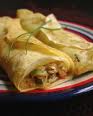
A savory Crepe does not include sweet treats. These Crepes act more as a meal and can be almost anything. I’ve seen breakfast Crepes stuffed with eggs, bacon, sausage, and cheese. I’ve seen lunch and dinner Crepes stuffed with everything you’d find in a taco, potatoes, vegetables, salad, and even chicken and mushroom fillings.
How do I get it?
Crepes have become very popular all over Europe. Here in America a Crepe is much harder to come across, especially savory Crepes. You can only find Crepes in authentic French restaurants and most often they only have sweet Crepes.
If you are interested in trying a Crepe you may have to call a few restaurants first to check so you don’t show up hoping they serve Crepes when they don’t, but believe me it is definitely worth the extra effort.
My absolute favorite Crepes are sweet Crepes with Nutella and banana filling sprinkled with a little powdered sugar on top. Yummm it makes my mouth water just thinking about it.
If you have never tried a Crepe you are definitely missing out! This is a delicious French dish that is a MUST HAVE!